
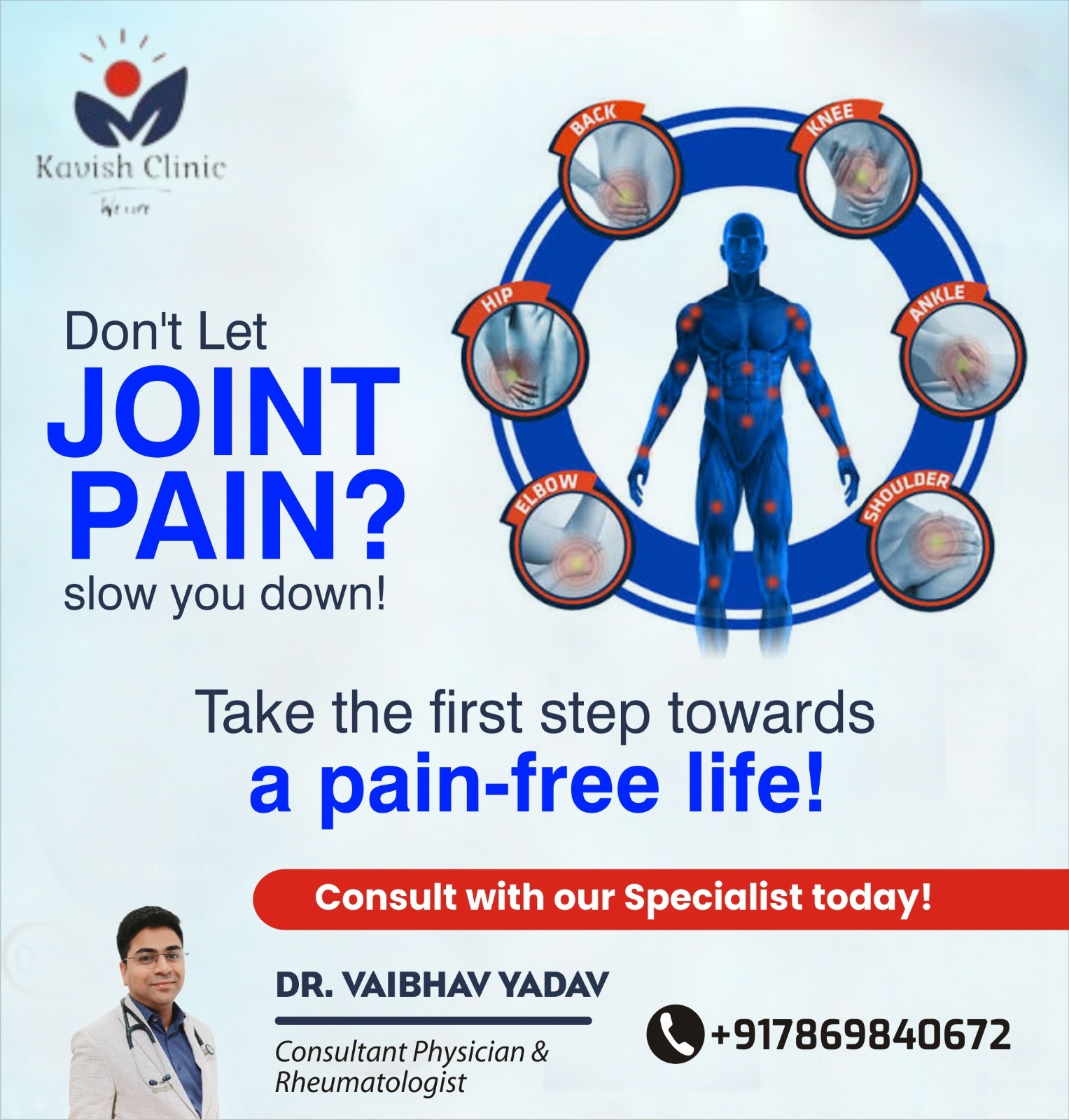
Joint Pain Treatment in Indore
Joint pain can affect simple activities such as walking, climbing stairs, getting out of bed, lifting objects, writing, exercising, or completing household work. Some people experience discomfort in one joint, while others develop pain and stiffness in several areas, including the knees, shoulders, hips, ankles, elbows, wrists, fingers, or spine.
Occasional soreness after unusual activity may settle with rest, but recurring swelling, morning stiffness, reduced movement, or pain without a clear injury should not be ignored. Professional Joint Pain Treatment in Indore focuses on identifying the cause rather than only suppressing symptoms temporarily.
Kavish Clinic – Dr. Vaibhav Yadav provides medical evaluation and personalised care for patients experiencing joint pain, inflammation, stiffness, swelling, and symptoms related to rheumatic or autoimmune conditions.
A joint is the area where two or more bones meet. Cartilage, ligaments, tendons, muscles, and a lubricating fluid work together to support movement. Pain may develop when any of these structures becomes inflamed, injured, worn, or affected by an underlying condition.
Common causes include:
Because these conditions require different treatment approaches, self-diagnosis can delay appropriate care.
A medical consultation is advisable when pain continues, returns frequently, or affects normal movement. You should consider visiting a Joint Pain in Indore when you experience:
Early assessment may help control inflammation, prevent joint damage, and preserve mobility.
The knees carry body weight during standing, walking, running, and stair climbing. Knee pain may develop because of osteoarthritis, injury, meniscus damage, ligament problems, inflammation, or excess strain.
Symptoms can include:
A Knee Pain Doctor in Indore may examine joint movement, stability, swelling, muscle strength, and walking pattern before recommending treatment.
The shoulder allows a wide range of movement, which also makes it vulnerable to stiffness, tendon problems, bursitis, arthritis, and injury.
Patients may experience pain while lifting the arm, dressing, combing hair, reaching behind the back, or sleeping on the affected side. Early treatment may help prevent increasing stiffness and weakness.
Hip pain may be felt in the groin, outer hip, thigh, or lower back. Possible causes include arthritis, bursitis, injury, tendon irritation, or inflammatory joint disease.
Professional Hip Pain Treatment in Indore is important when discomfort limits walking, standing, bending, or sleep.
Ankle pain may follow an injury, but repeated swelling or pain without trauma can also occur because of arthritis, gout, tendon concerns, or inflammatory conditions.
Foot and ankle symptoms can significantly affect balance and mobility, so persistent discomfort should be examined.
Elbow and wrist pain may be linked to repetitive work, sports activity, tendon inflammation, arthritis, nerve compression, or injury.
People using computers, tools, machines, or mobile devices for extended periods may notice pain, weakness, or stiffness during daily tasks.
Back pain can arise from muscles, discs, nerves, or spinal joints. Inflammatory back pain may present differently from ordinary mechanical pain.
Evaluation by a Rheumatologist in Indore may be useful when back pain begins at a younger age, causes prolonged morning stiffness, improves with exercise, or occurs with other joint symptoms.
Joint pain is a symptom, while arthritis refers to inflammation or structural disease affecting a joint. Not every painful joint has arthritis, and not every arthritis case produces the same symptoms.
Arthritis may cause:
A specialist determines whether the problem is inflammatory, degenerative, metabolic, infectious, or injury-related.
Rheumatoid arthritis is an autoimmune condition in which the immune system mistakenly attacks the lining of the joints. It commonly affects the hands, wrists, feet, knees, and other joints, often on both sides of the body.
Possible symptoms include:
Timely Rheumatoid Arthritis Treatment in Indore is important because uncontrolled inflammation may gradually damage joints and affect other parts of the body.
Osteoarthritis commonly develops when joint cartilage and surrounding structures change over time. It often affects the knees, hips, spine, and hands.
Symptoms may include pain during movement, stiffness after rest, reduced flexibility, and grinding sensations. Treatment depends on symptom severity, joint condition, activity level, and overall health.
Management may involve lifestyle changes, weight control, exercise, medicines, physiotherapy, and other options where appropriate.
Gout develops when uric acid crystals collect in a joint. It often causes sudden, intense pain, swelling, warmth, and redness, commonly in the big toe, ankle, or knee.
A gout attack may be severe enough that even light touch becomes uncomfortable. Medical evaluation is important because treatment may be needed both for the current episode and for long-term uric acid management.
A thorough evaluation helps determine the real cause. A Joint Pain Doctor in Indore may begin by asking:
The examination may include checking joint tenderness, warmth, movement, swelling, stability, strength, and functional ability.
Not every patient requires the same investigations. Depending on the symptoms, a doctor may advise:
Tests should be selected according to clinical need rather than ordered as a routine package for every patient.
The correct treatment depends on the diagnosis, severity, affected joint, age, activity level, and associated health conditions.
A doctor may prescribe medicines to reduce pain, control inflammation, or treat the underlying disease. Some inflammatory conditions require long-term disease-modifying treatment to prevent joint damage.
Patients should avoid prolonged self-medication because certain painkillers can affect the stomach, kidneys, liver, blood pressure, or heart risk.
Condition-specific exercise can improve strength, flexibility, balance, and joint support. A physiotherapist may recommend:
Exercise should be adjusted during active inflammation or after injury.
Excess body weight can increase pressure on weight-bearing joints such as the knees, hips, ankles, and lower back. Even gradual weight reduction may help improve movement and reduce joint strain.
Cold packs may help during acute swelling, while gentle warmth may be useful for stiffness in some conditions. The appropriate method depends on the cause and stage of symptoms.
Activity changes may reduce repeated strain. This can include improving workstation setup, using safer lifting methods, wearing suitable footwear, and taking movement breaks.
Selected patients may be considered for joint injections or other procedures. These options are not suitable for everyone and should follow a proper diagnosis.
Surgery may be considered when severe structural damage causes significant pain and loss of function despite appropriate non-surgical care. A rheumatologist or physician may coordinate referral to an orthopaedic surgeon when necessary.
Many people wait until pain becomes severe before seeking help. This may allow inflammation, stiffness, weakness, and functional limitations to increase.
Early Arthritis Treatment in Indore may help:
The goal is not only to reduce discomfort but also to preserve long-term joint function.
Simple habits can support joint care alongside medical treatment:
Supplements should not replace proper diagnosis and treatment.
Patients looking for Joint Pain Treatment Near Me in Indore may seek consultation from areas such as:
A conveniently located clinic can make regular monitoring and follow-up care easier, particularly for chronic rheumatic conditions.
A rheumatologist is trained to evaluate inflammatory, autoimmune, and systemic conditions affecting multiple joints. A consultation is especially important when pain occurs with swelling or prolonged morning stiffness.
Some forms of arthritis can be controlled effectively but may require long-term management. The treatment goal is to reduce symptoms, control inflammation, prevent damage, and maintain function.
No. Joint pain can affect people of any age and may be caused by injuries, autoimmune disorders, infections, gout, repetitive strain, or other conditions.
Appropriate movement is often beneficial, but the type and intensity of exercise depend on the diagnosis. During severe swelling or acute injury, activities may need modification. Seek personalised guidance before beginning a new routine.
Recurring knee, hip, shoulder, ankle, elbow, wrist, or back pain should not be allowed to gradually restrict your lifestyle. A timely medical evaluation can reveal whether the problem is related to arthritis, inflammation, injury, gout, or another condition.
For professional Joint Pain Treatment in Indore, consult Kavish Clinic – Dr. Vaibhav Yadav for detailed assessment, rheumatology care, personalised treatment planning, and long-term joint-health support.
Contact Us Today to Book Your Consultation and Take a Confident Step Toward Improved Mobility and Comfort.


